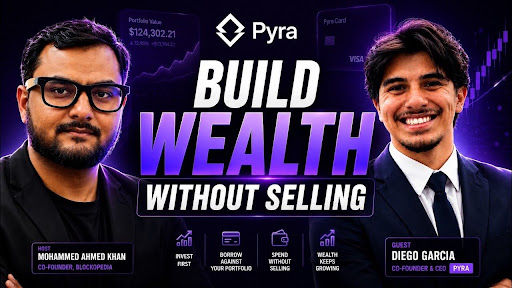
In this episode of The Blockopedia podcast, Pyra’s Co-founder and CEO Diogo sat down with The Blockopedia’s Co-founder Mohammad Ahmad Khan to talk about building a fintech app that lets users invest their entire paycheck into crypto and other assets, spend through credit instead of selling, and recover stronger after a major public setback with the Drift exploit.
Diogo’s path into crypto started early. He first heard about Bitcoin and Ethereum in high school through a friend, and instead of just trading, he went straight to reading white papers. That curiosity carried him through a computer science degree, where he experimented with DeFi spending tools, yield strategies and arbitrage trading before eventually landing in the Solana ecosystem, where he has built ever since.
His first real product was a simple DeFi comparison tool that tracked arbitrage opportunities between decentralized and centralized exchanges. It never took off, but he calls it a valuable first lesson in shipping something real and getting feedback.
What Pyra Actually Does
Diogo explained Pyra in plain terms: it is an investment app that lets people build wealth with money they would normally just spend. Traditionally, people invest whatever is left over after covering expenses, which for most people is very little given the cost of living. Pyra flips that. Users invest their paycheck immediately, then draw a line of credit against their portfolio to cover rent, groceries and bills, so the invested capital keeps growing instead of sitting untouched or never existing at all.
He described this as the same strategy wealthy individuals already use, often called buy, borrow, die. Instead of selling assets and triggering capital gains tax, they borrow against their holdings while staying fully invested. Pyra is built to make that same mechanism safe and accessible for everyday users, not just the ultra wealthy with financial advisors managing it manually.
Why Solana
Diogo chose Solana early because it offered speed and low costs at a time when other scaling solutions were still new. That advantage has only compounded, he said, thanks to a large existing DeFi ecosystem and the growing wave of tokenized stocks, bonds and commodities landing on chain. Going multi chain has simply never felt necessary.
A Conversation From the Co Working Floor
The interview itself took place in person at a co working space in Dublin, where Diogo’s team was based for Build Station, an event bringing Solana builders together ahead of the next Colosseum hackathon. His co-founder Errol was on site as well, working alongside him in a space shared with several other Solana ecosystem teams. The setting gave the conversation an unusually grounded, on the ground feel, less a polished studio interview and more a real look at a founding team mid build.
Colosseum, Setbacks and Trying Again
Pyra’s team competed in Solana hackathons twice, first with limited success under an earlier event before Colosseum existed, then again a year later with a far stronger product, which earned them fifth place. Diogo credits persistence as much as skill, pointing to other founders in the ecosystem who applied to Colosseum multiple times before eventually winning grand prizes.
Facing the Drift Exploit
Diogo did not shy away from discussing Pyra’s most public challenge, the Drift exploit. Rather than framing it as the end of the story, he described it as motivation to rebuild with stronger safeguards. Pyra is self custodial and currently integrates with Kamino for lending, but the longer term plan involves diversifying across multiple lending protocols, exploring portfolio insurance, and eventually bringing credit infrastructure in house to reduce reliance on third party risk entirely.
What’s Next
Pyra is expanding beyond crypto assets into stocks, bonds and commodities, aiming to make the platform approachable for everyday users who may be wary of DeFi terminology but understand something like an S&P index or Apple stock. Bank deposits and withdrawals are also coming, along with a risk engine designed to help users avoid liquidation during market downturns so their portfolios can compound over years rather than months.
Funding so far has come from a mix of a small pre seed round, personal funds, friends and family, and hackathon prize money. Diogo says the next step is raising a proper round from investors who believe in the long term vision.
Community and Trust
Asked how he manages community trust, especially after a public setback, Diogo pointed to transparency as the core principle: being open about what the team is building, and staying available to answer questions rather than going quiet.
In a round of rapid fire questions, Diogo named Solana as where he is most bullish right now, said he uses Telegram for business conversations and is expanding into Instagram and TikTok, and shared that his advice to any founder facing a setback is simple: communicate openly, because people are listening even when it does not feel that way.
Watch the full conversation: https://www.youtube.com/watch?v=uze-3Yigp74&t=50s